Guillaume de Machaut (1300-1377): De Fortune me dois plaindre et louer. Ensemble Musica Nova.
The life of Christine de Pizan
The first professional woman writer in French literature was born in Venice in 1364. She came to France at the age of four to join her father, an Italian astrologer who had entered the service of King Charles V. He strongly encouraged her studies, and Christine grew up immersed in books and learning. She married at fifteen and was happy with her husband, a royal advisor. Her world collapsed in 1389 when he died suddenly, leaving her a widow at twenty-five with three children, her mother and a niece to support.
Opportunists wasted no time trying to seize her property and what remained of her fortune. Overwhelmed and inexperienced in legal matters, Christine chose to confront the situation head-on and fought tirelessly against dishonest creditors in endless lawsuits. She also began writing poetry. Her early works were well received, and she recognized a path toward financial independence. She moved on to longer narratives on a wide range of subjects and circulated her books in manuscript form, since printing would not spread until after her death (Gutenberg invented the first movable-type printing press in Europe around 1450).
A major intellectual figure
Her success came quickly. Princes valued her work, and her reputation soon spread beyond France, with translations into English as early as the fifteenth century. She even ran her own manuscript workshop. Driven by a relentless hunger for knowledge and unwavering confidence, Christine expanded her expertise in many fields: moral philosophy with The Treasure of the City of the Ladies, history with The Book of the Mutability of Fortune, politics with The Book of the Body Politic, and even military strategy with The Book of Feats of Arms and of Chivalry. She navigated a turbulent and dangerous political landscape with remarkable diplomatic skill.
She also displayed boldness. In The City of Ladies and The Epistle of the God of Love, she challenged the misogyny of certain influential writers of her time, particularly Jean de Meun. After producing a substantial body of work and securing her children’s future, she retired to a convent in 1418 as civil war and English advances plunged France into chaos. She emerged from her retreat only once to celebrate the extraordinary courage of Joan of Arc in a poem that became the first written tribute to the heroine during her lifetime. Christine de Pizan likely died the following year, in 1431.
I have chosen
I have chosen for my joy (Let others have theirs), such is my way, Peace, voluntary solitude, And an abstract and solitary life.
The Book of the Mutability of Fortune.
Christine de Pizan and her time
Christine lived through some of the harshest decades of the Middle Ages. Between 1340 and 1440, France is estimated to have lost 41 percent of its population, devastated by the Black Death of 1348, civil war between the Armagnacs and Burgundians, dynastic conflicts and English conquests. King Charles VI suffered recurring bouts of madness from 1392 onward. The French knighthood, already weakened, was shattered by the English at muddy Agincourt in 1415. It was the end of an age shaped by fin’amor and heroic chansons de geste.
In this fading world, Christine wrote tirelessly about hope and the power of virtue. She urged readers to reject false misogyny and defended the dignity of women in the debate over the Roman de la Rose and later in The City of Ladies. She did not challenge the social structures of her time yet encouraged women to trust their moral and intellectual abilities and to recognize the value of their role at every level of society.
Christine de Pizan was never subjected to damnatio memoriae, yet her works shared the fate of much medieval literature. Their language and context slowly slipped out of collective memory. Over the centuries her legacy shifted with changing cultural values. She was celebrated by nationalists for her patriotism, rediscovered by Simone de Beauvoir in The Second Sex, and became especially influential in American gender studies in the 1970s. The Book of the Mutability of Fortune was first translated and published in the United States in 2017, while no complete edition exists in modern French. Ironically, the standard edition of her poem on Joan of Arc was produced by British scholars (A. J. Kennedy and K. Varty, Oxford, 1977).
Laugh in mourning
To sing joyfully with a sad heart And laugh in mourning is a difficult thing to do.
Poésies
Why Christine de Pizan is an extraordinary writer
Christine commands admiration for her resilience and hope throughout a life marked by loneliness and upheaval. She began as a poet. Her verse is consistently elegant and often technically impressive, though it is doubtful that poetry represents the peak of her achievement.
Her singular importance lies above all in her remarkable career and her bold defense of women. Thankfully, she often recounts her own experiences directly in her works before shifting into allegory. These autobiographical passages are deeply moving, especially given her talent for animating scenes with vivid detail, as in Le Dit de Poissy, when she visits her daughter in April:
The whole way there was full and covered With flowers, each with its eyes open Toward the sun that shone brightly
Main works
1401/1402
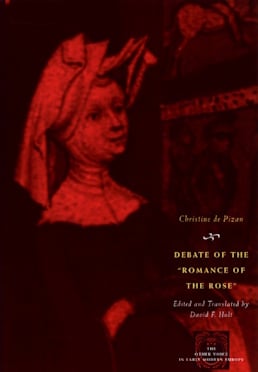
Debate of the Romance of the Rose
Christine de Pizan had little patience for Le Roman de la Rose. She was outraged by the way women were portrayed in this medieval bestseller and spoke out publicly against the contempt shown toward them not only in this work but in several other literary classics.
« What a fine doctrine! Is it such an accomplishment to deceive women? Who are these women? Are they snakes, wolves, lions, dragons, wyverns or ravenous beasts, enemies of mankind, that we must trick and capture them? Read your manuals. Learn to be cunning, to entrap them, to insult them, to storm their fortress and drag them all to shame! »
1403
The Book of the Long Study
After a deeply autobiographical opening centered on her widowhood, Christine de Pizan considers who is truly fit to govern “the universal machine.” Wealth? Knighthood? Noble birth? Wisdom? True to form, she supports her reflections with a wealth of examples drawn from antiquity and the Bible.
« I do not know whom you consider valiant. I can only tell you that the man I love stands so high in my regard that, whatever people may say, I make him shine in the eyes of the world, whether he is foolish or wise, handsome or plain. In short, when I cradle him to my breast, he is esteemed above all others. » (Lady Wealth)
1403
The Book of the Mutability of Fortune
A dense narrative poem of 24,000 lines, this ambitious work recounts the history of the world from Adam and Eve to Christine’s own day. Fortune and Misfortune determine who rises and who falls in a world constantly shifting and reshaping itself.
1404/1405
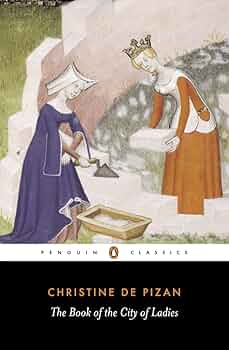
The Book of the City of the Ladies
The City of Ladies is not a blueprint for a society ruled by women. It is a metaphor for the inner fortress women must build to defend themselves against the widespread prejudices directed at them. Christine sets out to dismantle these biases through her own experience and through examples from the Bible and Greco-Roman antiquity.
« If it were customary to send girls to school and teach them the sciences as systematically as we teach boys, they would master and understand the challenges of every art and discipline just as well as boys do. »
1405
The Vision of Christine
In this book, which overturns many common assumptions about the Middle Ages, Christine recounts her life and how she began to write. Despite her success, she faces real hardship, prompting Lady Philosophy to intervene, comfort her and remind her of the joys she still has.
1405
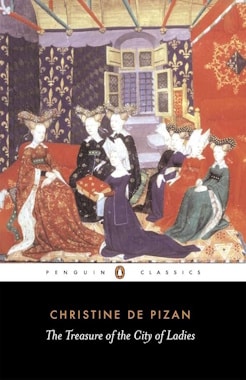
The Treasure of the City of the Ladies
Christine de Pizan addresses women from every social background, from princesses to prostitutes, offering guidance on what moral conduct means within the realities of their particular situations.
1407/1410
One Hundred Ballads
By the time Christine was writing, courtly love had largely faded from fashion. These ballads draw on its conventions while highlighting her originality through a more grounded and realistic approach to love.
Translated by A.S. Kline (2020). Free access online here.
1429
The Tale of Joan of Arc
In the early fifteenth century, the French kingdom stood on the edge of collapse. Silent since 1418, Christine de Pizan recognized the extraordinary, saving role of Joan of Arc and praised her as a woman touched by grace and an example for generations to come.
Translation: Resource: A. J. Kennedy and K. Varty, Oxford: Society for the Study of Medieval Languages and Literature, 1977. Free access online.
Manage cookie consent
We use cookies to optimise our website and our service.
Functional
Always active
Storage or technical access is strictly necessary for the legitimate interest of enabling the use of a specific service explicitly requested by the subscriber or user, or for the sole purpose of transmitting a communication over an electronic communications network.
Storage or technical access is necessary for the legitimate interest of storing preferences that are not requested by the subscriber or user.
Storage or technical access is necessary for the legitimate interest of storing preferences that are not requested by the subscriber or user.
Statistics
Storage or technical access used exclusively for statistical purposes.Storage or technical access is necessary for the legitimate interest of storing preferences that are not requested by the subscriber or user.
Marketing
Storage or technical access is required to create user profiles for the purpose of sending adverts, or to track the user across one or more websites for similar marketing purposes.