Major works (in french)
-
Ballade des dames du temps jadis
1461 - Le Testament
-
Epitre à ses amis
1461
-
Ballade des pendus
1462
Guillaume Dufay (1397-1474), “Adieu, ces bons vins de Lannoys”

François de Montcorbier was most likely born in 1431, the year Joan of Arc was burned at the stake. Orphaned at a young age, he was entrusted by his mother to a Parisian cleric, Guillaume de Villon, who raised, educated, and gave him his name. He studied in the Latin Quarter and earned a Master of Arts degree at twenty-one.
Student life in Paris was a fiercely independent world, often at odds with royal authority. Street brawls were frequent, and blades were drawn more readily than reason. One afternoon in June 1452, while François was sitting on a bench on the Rue Saint-Jacques, a priest named Philippe Sermoise picked a quarrel with him and hurled a stone that split his lips. Villon fled; the priest pursued him, and cornered, the young poet drew his sword and killed him.
Villon fled Paris and spent seven months in exile before receiving a royal pardon. He returned to the capital, but a year later, in 1457, a friend arrested by the police named him as an accomplice in the theft of five thousand écus from the Collège de Navarre. Forced to flee once again, Villon went to Blois, where the Duke of Orléans maintained a court of poets and courtiers. Villon joined the circle and composed several ballads, but soon fell out of favor and was compelled to leave.
In the summer of 1461, Villon was imprisoned for unknown reasons in a dungeon at the Château de Meung-sur-Loire, on the orders of Thibault d’Aussigny, Bishop of Orléans. When Louis XI was crowned King of France on 15 August, he passed through Meung-sur-Loire and ordered the release of several prisoners, among them Villon.
Grateful for his freedom, Villon thanked the king with a new ballad and returned to Paris, where he began work on his masterpiece, Le Testament. In 1462 he again became embroiled in a fight, this time with a notary on the Rue Saint-Jacques.
Public patience had run out. Villon was sentenced by the Provost to be strangled and hanged on the gallows of Paris. He awaited confirmation of the sentence in prison, fully aware of what likely awaited him. It was probably there that he composed the Ballad of the Hanged Men.
Parliament eventually overturned the death sentence, commuting it to ten years’ banishment. Villon left Paris on 8 January 1463. From that moment, his trail goes cold.

I know it well: had I applied
myself in youth to study and to good life,
I’d have a house and a soft bed.
But no—I played the fool,
ran from school like a bad child.
And now, writing this line,
my heart is nearly broken.
Testament, XXVI
Villon was born the year Joan of Arc was executed and was five when the English abandoned Paris — events that marked the closing years of the Hundred Years’ War. France lay exhausted, scarred by rival factions, battles, marauding soldiers, epidemics, and famine. Between 1436 and 1440, wolves killed some fifty to sixty people in the Paris region — and even within the city itself.
Life was fragile, precious, and perpetually under threat. Villon’s poetry conveys this awareness of transience, a haunting sense of mortality, and a mordant, often dark humor. Yet his age also produced extraordinary art. He was a contemporary of the Très Riches Heures du duc de Berry, a masterpiece of illumination that reflects a vision of the human body far removed from modern scientific thought.
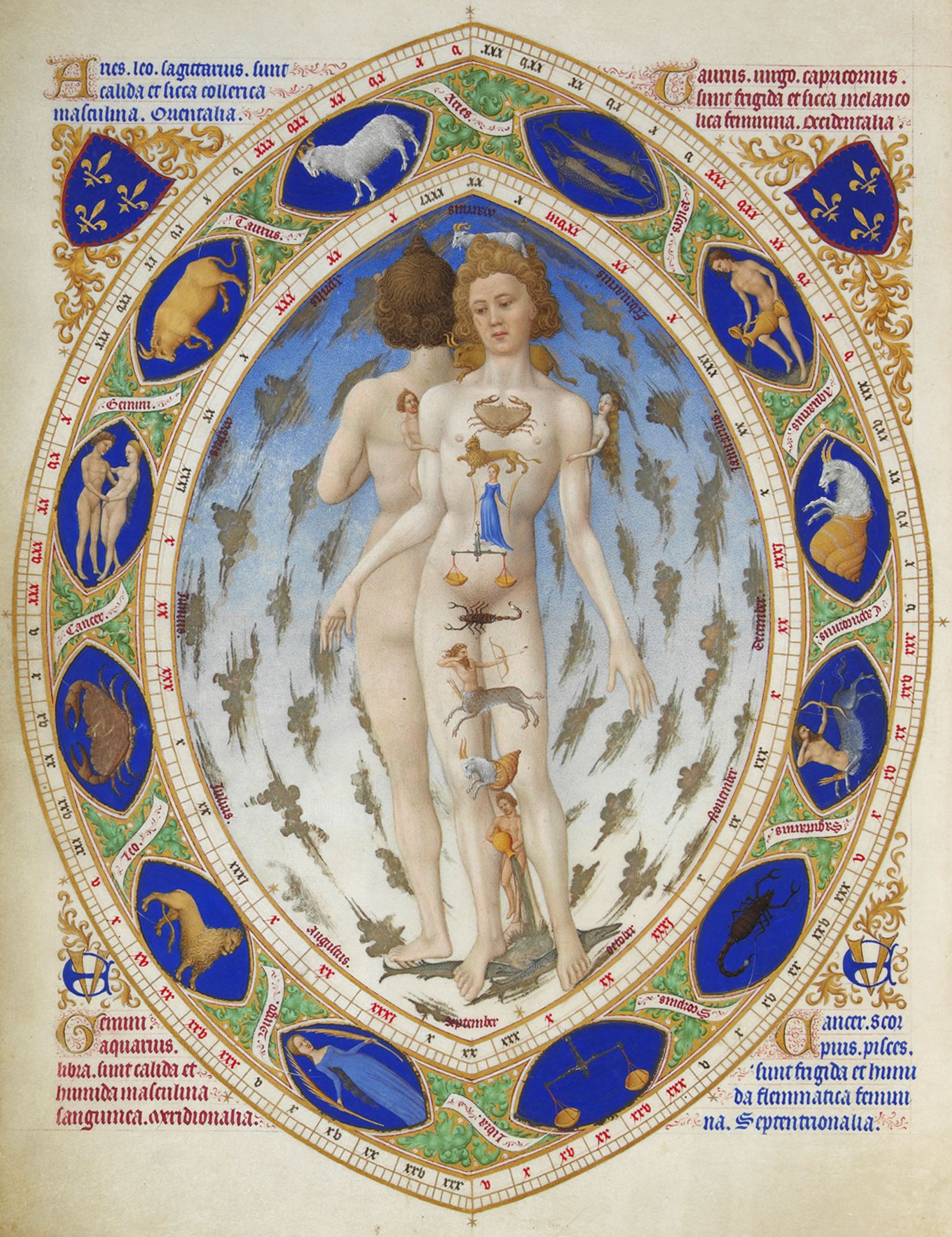
Let his flesh be minced
Finer than flour ground in a mill,
Or his sinews beaten raw,
Or let him lie naked on thorns;
And so that his death come sooner,
Let his body be filled with poison,
Or let him rot of hunger in prison,
Whoever blames another without cause.
Ballade morale

Villon’s work enjoyed considerable renown toward the end of the fifteenth century with the advent of printing, but his name gradually faded from memory until the Romantics rediscovered him around 1830. They were captivated by the Middle Ages and by the image of the accursed poet — a fascination reflected, for instance, in Victor Hugo’s Notre-Dame de Paris (1832).
From a literary standpoint, Villon may be regarded as the first unmistakably personal poet: writing from unvarnished subjectivity was far from common in his time. His criminal life only heightened the mystique surrounding his work, and he ultimately came to embody the very prototype of the transgressive poet.
Villon commands our attention through his life, his work, and the centuries that divide us from him. Reading him is like stepping back into another age while standing in places that still exist today. The Rue Saint-Jacques, where two decisive moments in his life unfolded, still runs alongside the Sorbonne.
Burlesque, tragedy, comedy, and bawdiness mingle in his verses, giving them the bite of strong liquor. Many of his puns and allusions to the student life of the Latin Quarter have grown obscure to us, yet his terror of death and his awareness of life’s brevity remain profoundly moving. Some of his lines are so tightly wrought that they have crossed six centuries without losing any of their power:
Je meurs de soif auprès de la fontaine.//“I die of thirst beside the fountain.”

1461 - Le Testament
1461
1462